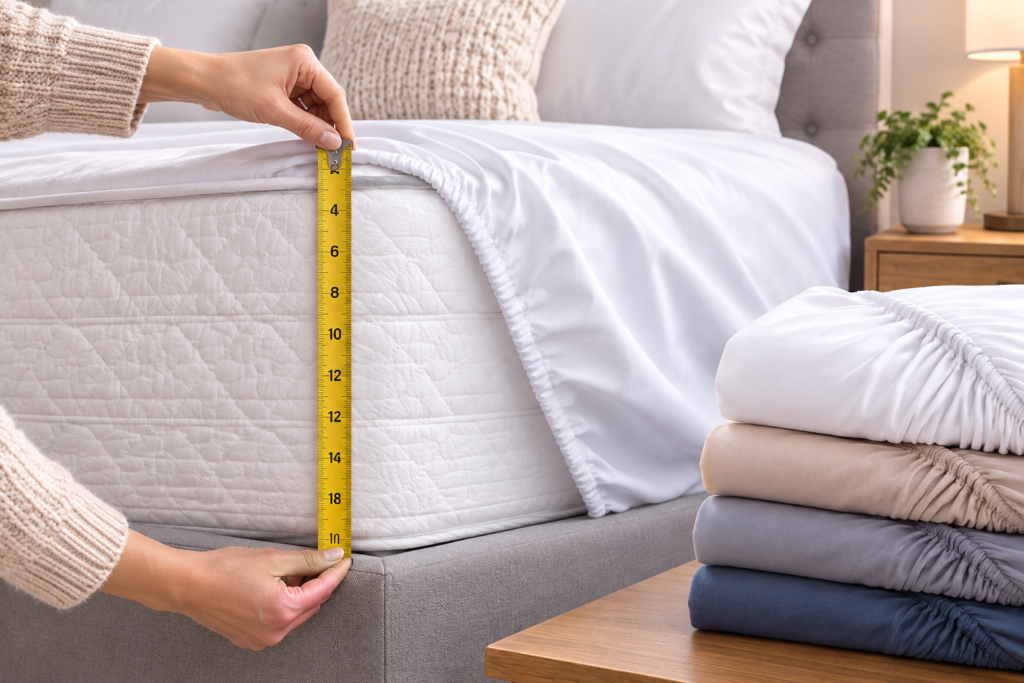
“Deep pocket” is printed on a lot of sheet packaging, but the actual pocket depth varies a surprising amount between brands — and buying the wrong depth is one of the most common reasons a brand-new fitted sheet doesn’t fit right out of the package.
Why Mattress Depth Trips People Up
Most people estimate their mattress depth by eye, or just remember it as “pretty thick.” But mattresses have gotten taller over the past decade — pillow-tops, gel layers, and hybrid foam constructions routinely push past 12″, and adding a mattress protector or topper adds even more. A sheet bought without an actual measurement is a guess, and a wrong guess means a sheet that’s either too shallow to grip properly or so oversized it bunches up.
How to Measure Your Mattress Correctly
Step 1 — Measure With Everything On
Measure your mattress with any topper or mattress protector already in place, since that’s the actual height the sheet needs to cover — not the bare mattress alone.
Step 2 — Check All Four Corners
Mattresses aren’t always perfectly uniform, especially pillow-tops. Measure at more than one corner and use the deepest measurement so the sheet fits everywhere, not just the spot you happened to measure.
Step 3 — Round Up, Not Down
If your measurement falls between two standard pocket depths, size up. A sheet with slightly more pocket depth than strictly necessary will still fit well; one that’s slightly too shallow will fight you every single time you make the bed.
Standard vs. Deep Pocket vs. Extra-Deep Pocket
- Standard pocket: roughly 7″–12″, fits older or simpler mattresses without added toppers.
- Deep pocket: roughly 12″–15″, the right range for most modern pillow-top and hybrid mattresses.
- Extra-deep pocket: 15″+, needed for thick memory foam mattresses stacked with a topper.
What Happens When the Pocket Is Too Shallow
A too-shallow sheet is stretched to its absolute limit just to reach over the mattress, which means the elastic is under constant maximum tension from the moment it goes on. That’s a recipe for a sheet that pops off within days and wears out its elastic far faster than it should.
A Zipper System Forgives Small Measuring Errors
One practical advantage of a zipper fitted sheet is that it doesn’t depend on elastic tension to grip the mattress, so it’s more forgiving of a measurement that’s slightly off in either direction. Sleep Tight’s sheets use an extra-deep 8″–16″ pocket range specifically so one sheet size comfortably covers standard mattresses through thick pillow-tops, without needing to hit an exact number.
Quick Reference
Measure your mattress with topper and protector on, at more than one corner, and round up if you’re between sizes. When in doubt, a slightly deeper pocket is always the safer choice over one that’s too shallow.
Common Measuring Mistakes
Measuring the Mattress Alone, Without the Topper
It’s an easy mistake — measuring the bare mattress and forgetting that a 2″–3″ topper will be under the sheet too. Always measure with everything that will actually be under the sheet in place.
Trusting the Size Label Instead of Measuring
A mattress marketed as “Queen” or “King” tells you the length and width, but says nothing about depth — that’s a separate spec that varies significantly between mattress models even within the same size category.
Not Accounting for Mattress Settling
New mattresses, especially foam ones, sometimes compress slightly over the first few months of use. If you’re buying sheets for a brand-new mattress, it’s worth remeasuring after a couple of months if the fit feels different than expected.
What If You’re Between Two Sizes?
When your measurement falls right between a standard and deep pocket, the safer choice is almost always to size up. A slightly deeper pocket than needed still holds a snug fit; a pocket that’s a half-inch too shallow will fight you every time you make the bed.
Tools You Actually Need
A flexible tape measure is really all it takes — measure from the top surface of the mattress (with topper on) straight down to the bottom edge at the corner. No special tools required, just a couple of minutes before you buy.
A Note on Fitted Sheet Elastic vs. Zipper Systems
Pocket depth matters no matter which fastening system a sheet uses, but the consequences of a slightly-off measurement differ. With elastic, a shallow pocket means the elastic is stretched to its limit and prone to popping off; with a zipper system, a shallow pocket mostly just means a tighter zip, which is a minor inconvenience rather than a nightly failure. That said, getting the measurement right the first time is still the easiest path to a sheet that fits well from day one.
Final Thoughts
A few minutes with a tape measure saves you from buying a sheet that never quite fits. Get the depth right, and everything else — how snug the corners stay, how long the elastic lasts, how easy the bed is to make — gets easier from there.